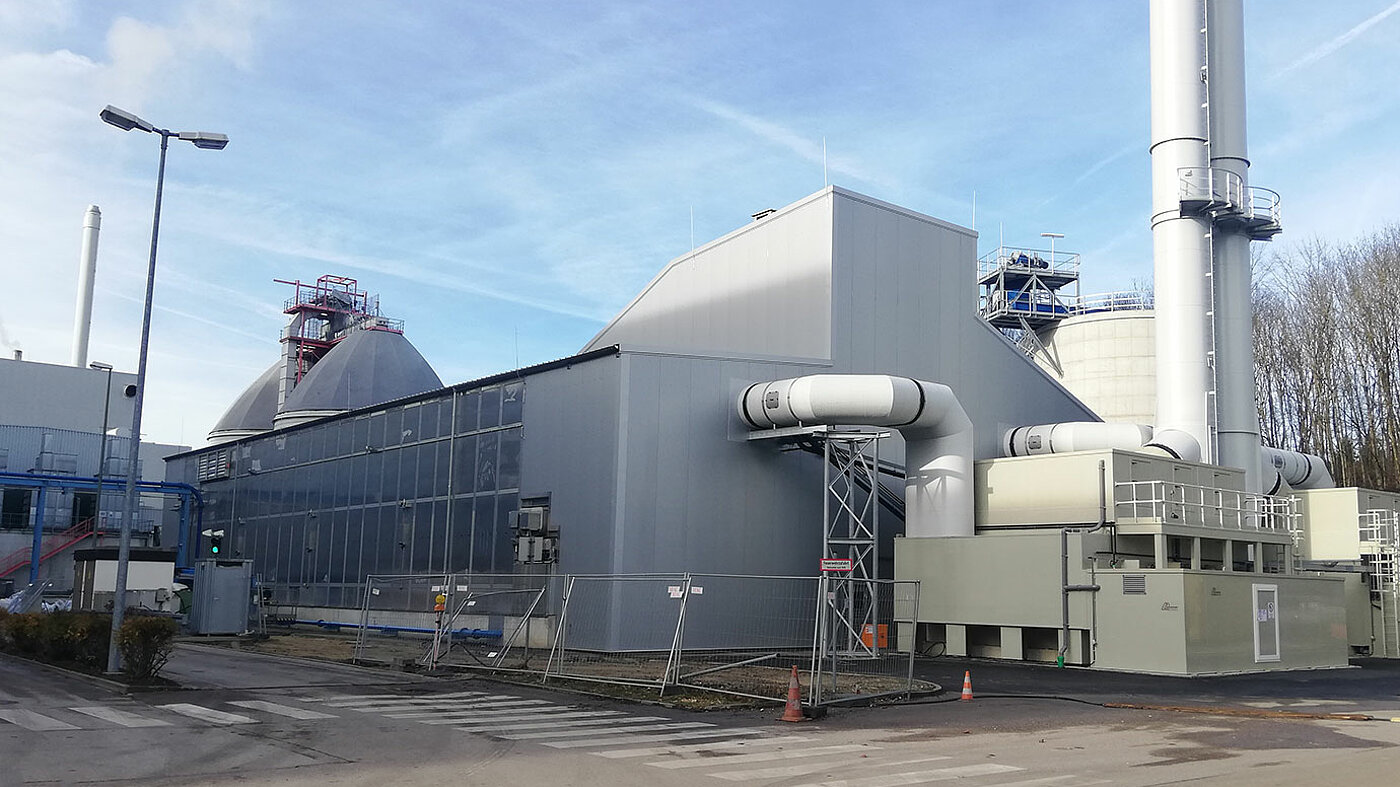







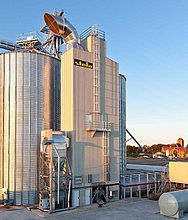
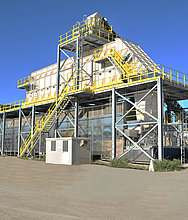
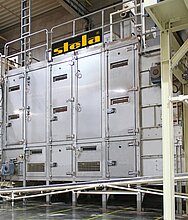
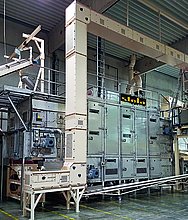
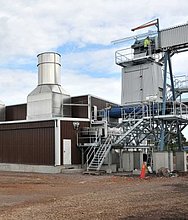
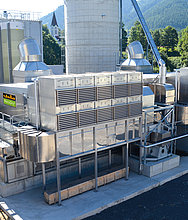
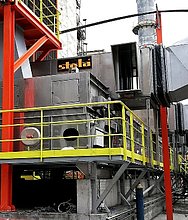
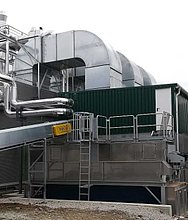
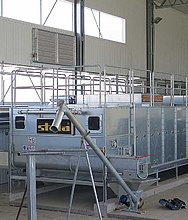
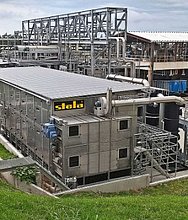
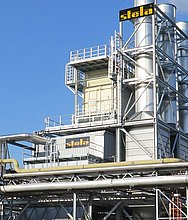
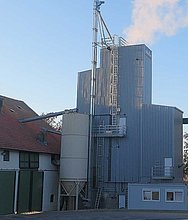
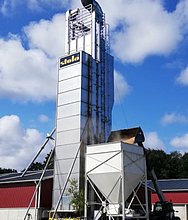

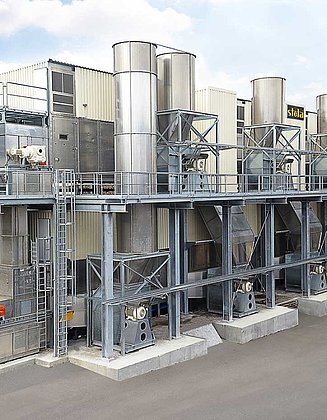
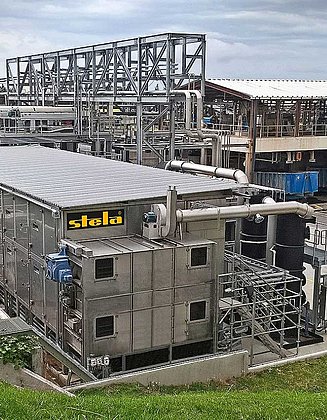
Belt Dryer BTU for sewage sludge
in Romania
Dryer type: BTU 1-6200-18
Dryer output capacity:
sewage sludge: 1.2 t/h from 90% to 25%

STELA Laxhuber develops low-temperature belt dryers for sewage sludge drying in municipal and industrial wastewater treatment plants – energy-efficient, low-emission, and designed for growing regulatory requirements. The BTS type belt dryer was developed specifically for this application: robust construction made of corrosion-resistant stainless steels, minimized exhaust air volumes, and a modular design for wastewater treatment plants of various sizes.
The disposal of sewage sludge is increasingly becoming a strategic issue for plant operators: agricultural application is restricted or prohibited in many countries, landfill capacities are limited, and new legal requirements for phosphorus recovery will take effect in Germany from 2029. Thermal utilization with upstream drying is the future-proof path for many operators: dried sludge can be burned efficiently, phosphorus can be recovered from the ash – and the volume for transport and disposal is significantly reduced.
The EU Sewage Sludge Directive as well as national laws such as the German Sewage Sludge Ordinance (AbfKlärV) are significantly tightening the requirements for the application of sewage sludge on agricultural land. From 2029 and 2032 respectively, mandatory limit values for phosphorus recovery from sewage sludge from larger wastewater treatment plants will apply in Germany. For plant operators, this means: anyone investing in a drying plant today is making a strategically important decision for the future.
Drying is a central step in this process: it reduces volume, increases the calorific value for thermal utilization, and enables subsequent phosphorus recovery from the ash.

For decades, application on fields was considered the standard solution. This option is dwindling – and plant operators need alternatives.
Increasing global industrialization, the increased use of medication, and urbanization have led to the agricultural application of sewage sludge on fields becoming increasingly problematic. In some countries, this is now prohibited or is planned to be prohibited in the future. The goal is to protect people and the environment from the introduction of pollutants. At the same time, it is important to preserve the phosphorus contained in the sewage sludge, as it is indispensable for agriculture – especially against the backdrop of limited global phosphorus reserves.

In practice, sewage sludges exhibit very different properties – not only in water content and chemical composition, but also in drying behavior. STELA Laxhuber can draw on numerous drying tests and extensive practical experience. In addition to treating the sludge with additives, the origin of the wastewater is particularly decisive:
Industrial sludges, e.g., from:
Municipal sewage sludges, influenced by:
This high variability poses major challenges for plant operators – adaptable drying technology is needed here.
To meet the complexity of the sludges, every sewage sludge drying plant from STELA Laxhuber is designed exactly to the specific requirements. Furthermore, the sludge dryer can be comprehensively adjusted during operation:
If required, an automatic final moisture control system takes over to always achieve the desired target moisture.
When drying sewage sludge, the exhaust air typically contains dust, odors, and other emissions. Since STELA Laxhuber belt dryers operate at low temperatures below 120 °C, this is advantageous for better compliance with emission limit values. Depending on requirements, multi-stage exhaust air scrubbers, biofilters, or other odor removal equipment are used. To keep the size and costs of these components low, STELA relies on minimized exhaust air volumes, supported by precisely designed recirculation technology. This allows the exhaust air treatment to be designed significantly smaller.
Sewage sludge is one of the most challenging materials to dry: high moisture content, aggressive constituents, and varying compositions place special demands on materials, design, and safety technology. The BTS was developed precisely for this purpose.
Sewage sludge—especially when combined with highly saturated air streams—poses special challenges. That is why STELA relies on the following features in the BTS:
Corrosion-resistant stainless steels (at least AISI 304, or higher-grade stainless steel depending on requirements)
Specially developed process belts
Explosion protection concept based on the CE risk assessment (dust)
Chemically resistant construction elements
Sewage sludge places special demands on drying technology: high input moisture and aggressive components. High-temperature processes such as drum dryers solve this task with process temperatures well above 120 °C – which increases energy consumption, raises VOC and odor emissions, and makes exhaust air treatment more complex in terms of technology and regulatory approval. STELA belt dryers operate with process temperatures below 120 °C. This has two decisive advantages for sewage sludge drying:
Lower emissions: Low process temperatures significantly reduce the release of volatile organic compounds (VOCs) and odorous substances – the necessary exhaust air purification is smaller and more cost-effective than with high-temperature processes.
Energy efficiency through waste heat utilization: The BTS can be operated directly with waste heat from sewage treatment plant operations – e.g., from digester gas combustion or combined heat and power (CHP) generation. High-temperature dryers are often not suitable for this in practice, as the available waste heat does not reach the required temperature level.
STELA Laxhuber has implemented sewage sludge dryers for municipal sewage treatment plants and industrial operators in several European countries.
SC Ness Projekt Europe, Buzău (Romania) – Sewage sludge drying for municipal wastewater
SC Ness Projekt Europe operates a municipal sewage treatment plant at the Buzău site, for which STELA supplied a BTLU 1/3000-12 type belt dryer for sewage sludge drying in 2025. The plant evaporates 1.0 t H₂O/h and dries municipal sewage sludge to the target dry matter (DM) content required for thermal utilization.

Helector S.A., Greece – Drying of digested sewage sludge
Helector S.A., a Greek company specializing in environmental and waste disposal services, has been using a STELA BTS 2/3000-9 type belt dryer for drying digested sewage sludge since 2026. With an evaporation capacity of 1.0 t H₂O/h, the plant is designed to meet the requirements of thermal utilization.


More information:
From January 1, 2029, the land-based application of sewage sludge is prohibited for sewage treatment plants with 100,000 population equivalents (PE) or more – from 2032, this will also apply to plants with 50,000 PE or more. Sewage treatment plants under 50,000 PE may continue to apply sludge to agricultural land.
In parallel, an independent obligation for phosphorus recovery is taking effect: Sewage treatment plants with 100,000 PE or more must recover phosphorus from 2029, and plants with 50,000 PE or more from 2032. The phosphorus obligation also applies to new plants with 10,000 PE or more from 2029. Drying the sewage sludge is a central step in this process: it is a prerequisite for thermal utilization, from whose incineration ash the phosphorus can be recovered. For many operators, thermal utilization will be the central disposal route in the future – even if the law formally allows other recovery processes.
It is not possible to make a general statement without specific project data—plant size, throughput, available heat source, and the desired dry matter (DM) content are the key parameters. As a general guideline: The thermal treatment of sewage sludge typically costs operators between €370 and €470 per metric ton of dry matter today—costs that can be partially offset by operating an in-house drying plant or reduced through negotiations with incineration facilities, since dried sludge has a significantly higher calorific value and commands more favorable terms. In addition, transportation costs are reduced due to the significantly lower weight after drying. As part of its project consulting services, STELA prepares a customized economic feasibility analysis—based on the actual sludge volume, the available waste heat, and local disposal costs.
Thanks to its modular design, the STELA BTS can be configured for wastewater treatment plants of various sizes—from smaller municipal facilities to large industrial operators. An important prerequisite: The sewage sludge must be digested, meaning it must have undergone an anaerobic digestion process prior to drying. Digested sludge no longer emits significant amounts of gas, which greatly simplifies explosion protection.
The initial dry matter (DM) content depends on the feed system: Drying via recirculation is possible starting at approximately 10% DM; after mechanical dewatering, the dry matter content typically ranges from 20 to 30% and is then fed via a pump with a matrix (“STELA Matrix Feed”). Whether a dedicated plant or a shared solution with neighboring wastewater treatment plants is more economical depends on the sludge volume and the local infrastructure. STELA advises operators as early as this planning phase.
The target dry matter content depends directly on the planned utilization route: For co-incineration in hard coal or cement power plants, a dry matter content of at least 60 to 70% is generally required. For mono-incineration in fluidized bed furnaces – the preferred process in Germany, which enables targeted phosphorus recovery from the ash – dry matter contents of 80 to 95% are typically targeted. For pyrolysis, specific requirements apply depending on the plant manufacturer. Co-incineration in coal-fired power plants is limited in the medium term as a permanent utilization route. STELA designs the drying plant for the agreed target dry matter content and ensures compliance through an automatic moisture measurement control system.
The BTS can be adapted in a modular fashion to different slurry consistencies: Liquid sludge with a dry matter (DM) content as low as approximately 10% can be processed via recirculation; pumpable and moldable sludge with a DM content of approximately 20% or higher can be processed via a pump with a matrix (“STELA Matrix Feed”); and solid and lumpy sludge with a DM content of approximately 40% or higher can be processed via a double-screw distributor. The dry matter (DM) content indicates what percentage of the sludge is actually solids; the rest is water. The target moisture content after drying can be individually adjusted depending on the recovery method. For thermal recovery via incineration or pyrolysis, dry matter contents of 80 to 95% are typically targeted.
Low-temperature belt dryers like the STELA BTS operate with process temperatures below 120 °C. This offers two significant advantages over high-temperature processes: emissions are significantly lower, and the explosion risk from volatile gases in the drying process is considerably reduced. Drum dryers require significantly higher temperatures, which increases energy consumption and makes exhaust air treatment technically more complex and costly.
Since the BTS operates with low temperatures and minimized exhaust air volumes, the necessary exhaust air treatment is smaller from the outset than with high-temperature processes. Depending on site requirements and permit conditions, multi-stage exhaust air scrubbers, biofilters, or combination solutions are used. The significantly reduced exhaust air volume lowers both the investment costs and the ongoing operating expenses of exhaust air purification.
STELA Laxhuber assumes to dry only digested sewage sludge. Digested sludge no longer emits any significant gases, so explosion protection focuses on dust emissions. The BTS is therefore designed and manufactured according to a comprehensive explosion protection concept that meets the requirements for dust explosion protection. The dryer as a whole is not certified separately; the explosion risks are assessed as part of the CE risk assessment and addressed by the protection concept.
Yes. Industrial sludges from the paper industry, food processing, or chemical industry can have widely varying pH values, solid compositions, and pollutant contents. These properties influence the choice of materials, the design of the process belts, and the necessary exhaust air treatment. STELA conducts individual drying tests for every application and designs the plant specifically for the specific sludge properties.
The modular construction of the BTS allows for a precise design tailored to the actual throughput requirement – from compact individual plants for smaller wastewater treatment plants to multi-stage systems with high capacity for large industrial operators. A subsequent capacity expansion is generally possible, which increases investment security and allows for gradual scaling.
Phosphorus is a finite raw material that is indispensable for agriculture. During the thermal utilization of dried sewage sludge, phosphorus concentrates in the incineration ash and can be specifically recovered from there. Drying is therefore a technical prerequisite for closed phosphorus cycles. In Germany, the Sewage Sludge Ordinance (AbfKlärV) obliges operators of larger wastewater treatment plants to recover phosphorus from 2029 or 2032 onwards – investing in a drying plant is therefore also a regulatorily future-proof decision.

Low temperature, continuous dryer, circulating dryer – not sure what’s the best choice for you? Our experienced colleagues will be happy to help you find the best solution for your product. Please feel free to contact us without obligation.
Telephone +49 8724 899-10
Email sales[at]stela.de